
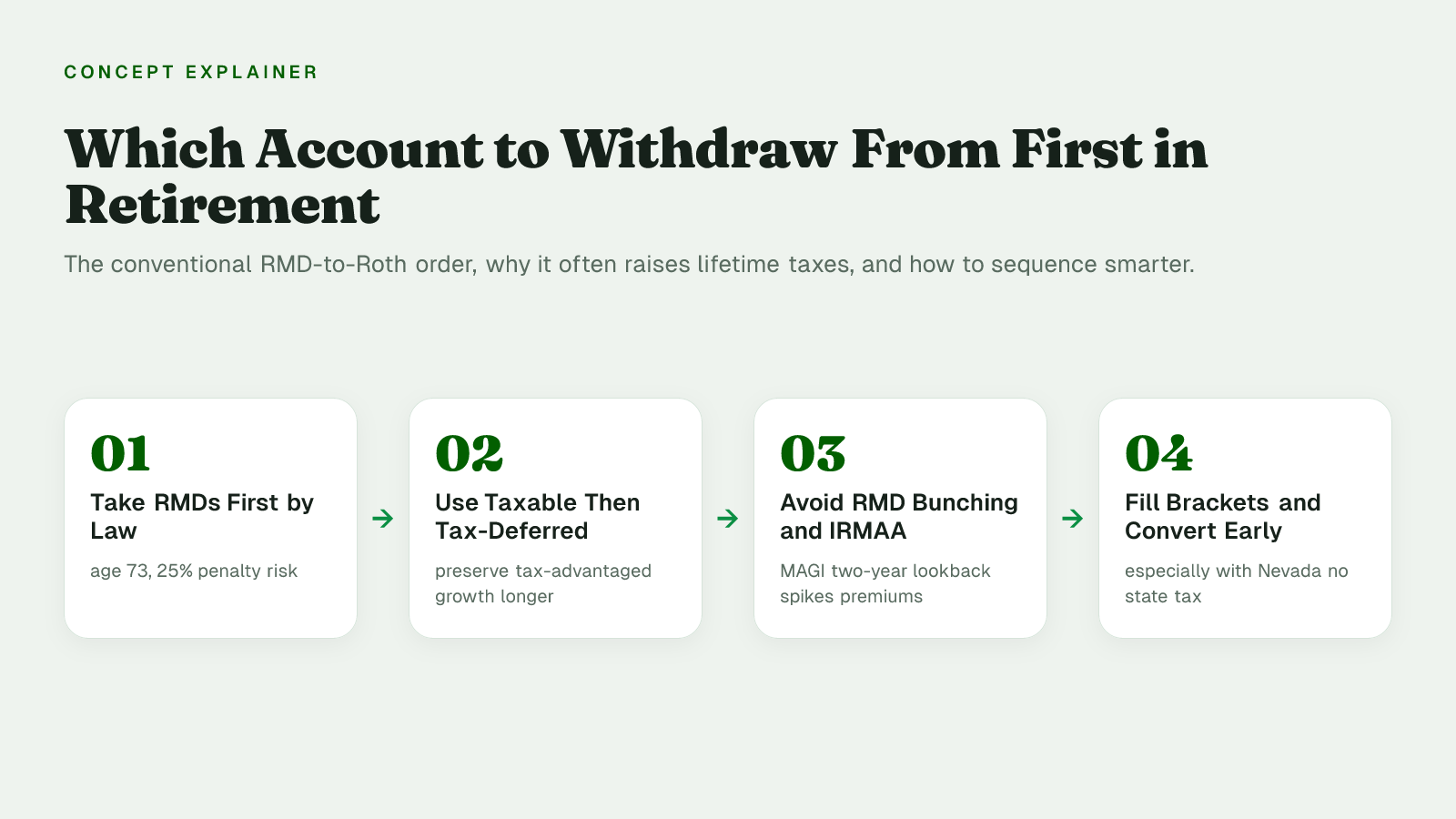
- Standard withdrawal order is RMDs first starting at age 73, then taxable brokerage, then traditional IRA beyond RMDs, then Roth last.
- Missing an RMD can trigger 25% excise tax on the amount not withdrawn, reduced to 10% if corrected within two years.
- IRMAA for 2025 starts at $106,000 single or $212,000 joint and uses MAGI from two years prior to set premiums.
- Social Security becomes partly taxable above $25,000 single or $32,000 joint combined income and up to 85% taxable above $34,000 single or $44,000 joint.
- Since 2024 Roth accounts in employer plans no longer have RMDs, allowing qualified Roth withdrawals to stay tax-free for legacy.
Which Account Should You Withdraw From First?
The conventional order is to take any Required Minimum Distributions first if you have them, then draw from taxable brokerage accounts and cash, then from traditional tax-deferred IRA and 401(k) accounts, and leave Roth IRAs and Roth 401(k)s for last. That sequence is a safe default designed to avoid penalties and let tax-advantaged money keep growing, but it is not automatically the lowest lifetime-tax path. In many years, deliberately filling a lower tax bracket or doing a partial Roth conversion beats following the order rigidly.
Two common situations change the math: waiting too long to touch tax-deferred accounts can bunch income into later years when RMDs grow larger, and low-income years early in retirement (often before Social Security begins) can be better used by intentionally filling lower tax brackets rather than following a rigid sequence.
Thinking in terms of a written retirement income plan helps you move from a generic rule to a sequence that reflects your actual mix of accounts and timing. Here’s exactly how the standard order works, why each step exists, and where it breaks down.
The Standard Withdrawal Sequence, Step by Step
Many retirees assume the order doesn’t matter as long as they have enough cash. It does, because each account type is taxed differently and carries different IRS rules. Once you reach age 73, the sequence runs: required minimum distributions first, then taxable brokerage and cash, then discretionary withdrawals from traditional IRA and 401(k) accounts, then Roth accounts last.
Here is the logic behind each rung:
1. Required minimum distributions first. The IRS requires you to start withdrawals from traditional IRA, SEP, SIMPLE, and workplace plan accounts when you reach age 73. If you fail to take the full RMD, the amount not withdrawn may be subject to a 25% excise tax, 10% if corrected within two years. You can withdraw more, but you cannot roll an RMD into another tax-deferred account.
2. Taxable brokerage, savings, and dividends second. These dollars have already been taxed, so you pay only capital-gains tax on growth, often at a lower rate than ordinary income. Spending them next lets tax-deferred and tax-free accounts keep growing.
3. Traditional IRA and 401(k) beyond RMDs third. Additional withdrawals are taxed as ordinary income, which makes them useful for filling up lower tax brackets intentionally.
4. Roth IRA and Roth 401(k) last. Qualified Roth IRA withdrawals are tax-free and Roth IRAs have no lifetime RMD for the owner. As of 2024, RMDs are no longer required from Roth accounts in employer retirement plans, so both Roth types can now compound untouched for future needs or legacy.
| Account Type | Tax Treatment on Withdrawal | RMD Status | Penalty Risk | Best Use in Sequence |
|---|---|---|---|---|
| Traditional IRA, 401(k), 403(b) — RMD amount | Taxed as ordinary income except basis | Required starting at age 73 | 25% excise, 10% if corrected within 2 years | Take first to satisfy law |
| Taxable brokerage, savings, dividends | Capital-gains rates on gains; principal untaxed | No RMD | No IRS penalty | Use after RMDs to preserve tax-advantaged growth |
| Traditional IRA, 401(k) beyond RMD | Taxed as ordinary income | RMD already satisfied | Ordinary income tax only | Draw next for bracket management |
| Roth IRA and Roth 401(k) | Qualified withdrawals tax-free | No lifetime RMD for owner; Roth 401(k) RMD eliminated 2024 | — | Save for last for tax-free growth and legacy |
This order is the starting point most advisors use because it satisfies the law first, then preserves the most valuable tax advantages the longest.
Where the Standard Order Backfires: RMDs, IRMAA, and Social Security
IRMAA surcharges for 2025 start when your Modified Adjusted Gross Income from two years earlier exceeds $106,000 filing single or $212,000 filing jointly. That two-year lookback is why many retirees get surprised by a premium jump long after the income year is closed.

If you leave traditional IRA and 401(k) balances untouched until required minimum distributions begin, those forced withdrawals stack on top of Social Security and any other income. Instead of spreading ordinary income evenly through your 60s, you bunch it into your mid-70s. A larger RMD can lift you into a higher federal bracket than you would have faced earlier, even though your spending never changed.
The same income spike lifts the MAGI figure Medicare uses for IRMAA. Social Security Administration tables show MAGI is based on your tax return from two years prior to set the next year’s Part B and Part D premiums. Cross an IRMAA threshold one year and your monthly Medicare costs rise roughly two years later, with the adjustment charged per person for both Part B and Part D.
Social Security taxation adds a third layer. The IRS determines taxability using combined income: half your Social Security plus other income like pensions, wages, interest, dividends, and IRA withdrawals. If that total is more than $25,000 single or more than $32,000 married filing jointly, part of your benefits becomes taxable. Up to 50% is taxable in the $25,000 to $34,000 single and $32,000 to $44,000 joint ranges, and up to 85% is taxable when income exceeds $34,000 single or $44,000 joint. Pulling from a traditional account raises that combined income dollar for dollar, while qualified Roth withdrawals do not count toward it.
Following the standard taxable-then-tax-deferred-then-Roth order on autopilot can quietly push your MAGI over an IRMAA cliff and raise your Medicare premium two years before you connect the cause.
The fix for income bunching isn’t a different order. It’s using the right account in the right year, including years most retirees ignore.
Bracket-Filling and Strategic Roth Conversions Before RMDs Hit
Bracket-filling with partial Roth conversions is the deliberate choice to use low-income years (often the gap after you stop working but before Social Security and Required Minimum Distributions begin) to pull enough from a traditional IRA or convert to Roth to fill your current federal bracket instead of leaving that room unused. In 2025 that can mean topping up taxable income to $48,475 for a single filer to stay within the 12% bracket today, rather than facing a higher rate later when RMDs increase your income.
The math works because federal tax brackets for 2025 are marginal, so you only pay the higher rate on the dollars inside that new layer. For 2025, the IRS shows single filers pay 10% up to $11,925, 12% up to $48,475, and 22% up to $103,350; married filing jointly thresholds sit higher across each of those same brackets, so the strategy scales to your filing status rather than changing in kind.
A common scene: you retire at 62, live on taxable brokerage cash, and have not yet started Social Security. You intentionally convert just enough from a traditional IRA to reach the top of the 12% or 22% bracket. Paying tax now at that known rate can shrink the traditional balance that later drives RMDs, which in turn can lower lifetime taxes and help limit future Medicare premium surcharge exposure.
The trade-off is real. You give up tax deferral and you need cash outside the IRA to pay the tax bill, so you do not erode the amount that moves into Roth. And conversions carry their own holding rules: each conversion has its own five-year clock starting January 1 of the year you convert, and withdrawing converted principal before that period when you are under age 59½ can trigger a 10% penalty.
Once a retiree sees the value of filling brackets deliberately, the next question is which state’s tax rules are doing the filling, because state tax changes what that bracket math actually costs you.
Why Nevada’s No State Income Tax Changes the Math
A Henderson or Las Vegas retiree withdrawing from a traditional IRA or 401(k) pays only federal tax on that distribution, not an additional state tax, because the State of Nevada does not impose a state income tax on individuals. That single-layer tax changes the tradeoff retirees in high-tax states face every time they decide which pot to tap.
In states like California, a traditional withdrawal or a Roth conversion is typically taxed twice, federal plus state. In Nevada, the same action carries only the federal cost. The practical result is two-fold: pulling from tax-deferred accounts a little earlier in retirement is less expensive than it would be elsewhere, and a Roth conversion done while you live in Nevada avoids a state tax bill that you would pay if you waited until after a move.
That second point matters for conversion timing. If you are considering a move out of Nevada, completing planned conversions while you are still a full-time Nevada resident can keep the bill to federal only. Conversely, if you split time between Nevada and another state, or plan to relocate to a state that does tax retirement income, your future residency determines whether those later traditional withdrawals will pick up a new state tax.
Summerlin or Las Vegas residency does not remove federal rules, but it does simplify the math and often makes early, deliberate use of traditional and Roth strategies more attractive than the generic national guidance assumes.
All of this, sequencing, conversions, and Nevada’s tax backdrop, only pays off when it’s mapped to one retiree’s actual numbers.
Building a Withdrawal Sequence That Fits Your Actual Accounts
Retirees in Henderson who mapped withdrawals for the next 24 months before taking their first distribution found the clearest way to keep lifetime taxes down: a sequence shaped around their own timeline, not a generic rule.
Personalized retirement planning for Las Vegas, Henderson, and Summerlin residents, helping you connect financial decisions with your life priorities—from income and investments to healthcare and family legacy.
Before you finalize anything, work through three questions that change the order every time:
- How old are you relative to RMD age? The years before required distributions begin often create a window to move money at a lower rate, while the years after they begin reduce flexibility.
- What mix of taxable, tax-deferred, and Roth balances do you actually hold? The size of each bucket determines how much room you have to fill a bracket without pushing into the next one.
- What income do you need this year versus what tax-bracket headroom remains? Your spending needs and other income set the floor; your current bracket sets the ceiling for intentional moves.
The reason the right order rarely stays the same two years in a row is practical. Account values move, tax tables adjust, and Medicare thresholds reset. A sequence that worked at 62 while living on brokerage cash will look different at 68 with larger traditional balances and new health coverage rules. Treating it as a one-year decision you revisit, rather than a one-time rule, keeps you from locking in higher taxes later.
If you want that yearly check built around your actual accounts, RMD timeline, and residency in Las Vegas, Henderson, or Summerlin, Retirement Risk Managers can help put together a coordinated withdrawal and Roth-conversion plan you can adjust as life changes.
Sources
- www.irs.gov
- Secure Act 2.0 | What the new legislation could mean for you
- SSA – POMS: HI 01101.020 – IRMAA Sliding Scale Tables
- IRS reminds taxpayers their Social Security benefits may be taxable | Internal Revenue Service
- Federal income tax rates and brackets | Internal Revenue Service
- What to Know About the Five-Year Rule for Roths
- tax.nv.gov
Frequently Asked Questions
What actually happens if I miss a required minimum distribution?
If you do not take the full amount, the IRS can assess a 25% excise tax on the shortfall, lowered to 10% if you correct within two years. You must still withdraw the missed amount and file Form 5329. That penalty risk is why RMDs come first in any sequence.
Do I still have to take RMDs from my Roth 401(k)?
No. As of 2024, RMDs are no longer required from Roth accounts in employer retirement plans under SECURE 2.0. Like Roth IRAs, which have no lifetime RMD for the owner, Roth 401(k)s can now be left to compound for later tax-free use.
If my income jumps for one year, how long will my Medicare premium stay higher?
Medicare uses MAGI from two years prior to set premiums. IRMAA surcharges for 2025 start above $106,000 single or $212,000 joint, so one high-income year can raise Part B and Part D costs about two years later.
Will pulling from my Roth make more of my Social Security taxable?
Qualified Roth withdrawals do not count toward combined income. Traditional IRA withdrawals do, and if that total exceeds $25,000 single or $32,000 joint, part of benefits becomes taxable, with up to 85% taxable above $34,000 single or $44,000 joint.
Can I do a Roth conversion after I have started taking RMDs?
Yes, but you must take your RMD for the year first. An RMD itself cannot be converted or rolled into another tax-deferred account, only amounts beyond the RMD can be converted. Many retirees use that extra amount to fill a lower bracket.
What is the five-year clock on a Roth conversion if I am under 59 and a half?
Each conversion clock starts on January 1 of the year you convert. If you are under age 59 1/2 and withdraw converted principal before the five-year holding period, you can owe a 10% penalty.
Should I intentionally withdraw more than I need to fill a lower tax bracket?
Often yes in early retirement. You pay the higher rate only on the part that’s in the new tax bracket, so topping up taxable income to $48,475 single in 2025 to stay within the 12% bracket can shrink future RMDs and lifetime taxes.
I plan to leave Nevada, should I accelerate Roth conversions before I move?
It can help. Nevada does not impose a state income tax on individuals, so a conversion done while a Nevada resident incurs only federal tax. If you move to a state that taxes retirement income, the same conversion later could cost federal plus state.